





Lines On The Water
The Modern Angling Club – it’s time to look at how we can make them better
Most angling clubs were established in the last century. Many were formed in the sport’s post-war golden era, but some of the larger clubs were formed in the early part of the 20th Century, or even earlier. Society has changed immeasurably since then, but some clubs have not kept up, meaning that their structure and rules might no longer be fit for purpose. Clubs can be at risk for many reasons – society is more litigious, club membership is more transactional than social, legislation will continue to evolve and, as a result, impact on how clubs work, and members are not only harder to recruit but also harder to retain. In this guest blog, retired lawyer JOHN ASTON, a member of our Fisheries Advisory Group, offers guidance on why clubs need to think about their structure and the importance of robust constitutions.
Introduction
There are seven key areas this article will focus on:
1. Structure
Some, perhaps even most, angling clubs have no legal identity in their own right. This can lead to an increased risk of personal liability for officers. Tellingly, some clubs, even very large ones, are not aware of their lack of legal status and its implications.
2. Governance
Non-incorporated clubs sometimes have cumbersome and over-complicated governance arrangements. Constitutions can stipulate the establishment of multiple committees and sub committees, often without clear terms of reference and which are also populated with too many members to operate effectively. The fact that some clubs also appoint trustees can make matters even more complex.
3. Rules
Rules need to be clear, enforceable, realistic and necessary. But some club rules might not have changed since the club’s formation nor ever have been properly reviewed. Just as some new rules become necessary, other rules become superfluous, unenforceable, or even unlawful. Risk management, health and safety and safeguarding are all issues clubs need to manage carefully and effectively.
4. Information Technology
The internet has offered huge opportunities for clubs to operate and communicate in different ways. But some clubs have been reluctant to embrace change and exploit opportunities. Despite falling memberships, a club might still operate in the same way which it has done for generations, despite the massive changes in society. If opportunities to use new technology are ignored, clubs can become less efficient than they could be, as well as less credible to younger members who have grown up with smartphones and connectivity. Obvious candidates for exploitation of what used to be called the new technology include maps of club waters, club website, social media, catch returns, signage and membership documents.
5. Sharing and Merging
Some big towns still have several large angling clubs, sometimes operating in virtual competition. It’s not unusual for the fishing rights on 10 miles of river to be controlled by nearly as many clubs. The same anglers might need to buy several different club memberships to fish their favourite part of the river. Some clubs already are exploring sharing waters with other clubs but more need to do so. Clubs will thrive more through co-operation than opposition. And, if they are effectively fishing in the same pond for the same members why not even consider a merger?
6. Health and Safety
Fishing can involve dealing with many different hazards, from aggressive cattle to steep riverbanks. Clubs cannot guarantee members’ safety but they should take reasonable steps to alert members to potential risks. It is in everyone’s interest to do so, especially in the case of junior and inexperienced members.
7. Making it Happen
It’s not always easy convincing members that changes are necessary. Making changes happen can be a challenging task and there are many pitfalls. Some practical guidance concludes this note, borne out of personal experience in club management.
PLEASE DON’T THINK that this note is intended to be a negative criticism of angling clubs. None of the recommendations are compulsory, and many clubs will continue to operate successfully without embracing change. But it can be a good idea to have a long hard look at how things work, and to explore if there might be better ways of doing them. This blog is intended to help clubs do just that.
1. STRUCTURE

There is widespread misunderstanding about the legal status of clubs. Most are what are called unincorporated associations, and they have no legal ‘personality’. Any transaction made by the club – such as renting a fishery – is done so by individual officers of the club, acting on its behalf.
This means that there is a risk of officers becoming personally liable for commitments made by the club, or for other liabilities such as claims made against it, or even fines. Insurance can help, but it doesn’t cover every liability and does not apply to fines for criminal behaviour by the club, such as a breach of Health and Safety legislation. It’s temptingly easy to assume that because a club has insurance, it will cover every risk. Be aware too that if a club has not disclosed relevant changes (such as the number of members or type of water rented) an insurer may be entitled to withdraw cover, leaving the club responsible for its liabilities.
There are other issues which can be problematic – because a club does not have ‘legal personality’, club property (whether rented or owned outright) is held in the name of officers. When an officer dies, or leaves the club, costs and delay can be incurred in the legal processes required in replacing the officer as club nominee.
The alternative model for a club is a limited company, usually a company limited by guarantee (‘CLG’). A company has ‘legal personality’ and can own property and enter into other commitments in its own name. Liability is limited, meaning that if a company’s liabilities exceed its assets, then it can be wound up. In most circumstances a CLG’s directors are not liable for a company’s debts, and the usual CLG model means that a member is only liable for the amount they have guaranteed – which is usually £1. There are more formalities involved in setting up and operating a company than for an unincorporated association. These include the obligation to submit annual accounts and to lodge details of directors’ appointments and other company documents with Company House. A company may also be liable to pay corporation tax on profits, although this risk is perhaps small in the case of most angling clubs.
The CLG model has been adopted by many clubs, especially those with smaller, closed memberships, and the Angling Trust itself is a CLG.
A brief word about charities. The word ‘charity’ denotes purpose, but not structure. A charity can take many forms, including a club, company, partnership or trust. Most smaller charities are run by trustees acting under an established charitable trust. There are extensive legal rules about the operation and registration of charities, and the model is rarely advantageous for an angling club.
2. GOVERNANCE

Unincorporated clubs usually operate through one or more committees, with individual officers being appointed for specific areas of responsibility – chair, secretary, treasurer etc. The club will normally have a constitution which stipulates how the club will operate, including provisions about appointment of officers, operation of club meetings including AGM, membership provisions etc.
CLGs are managed by a board of directors, typically a team of 5-10, some with specific responsibilities, others ‘without portfolio’ who will often take on specific projects. The operation of a CLG is stipulated by its memorandum and articles of association whose contents specify the company’s objects and how it will operate. These documents are filed with Companies House and are public documents available online.
Committees and Boards generally – some clubs are run by committees which have 20 plus members, and exceptionally even more than 40. It is difficult to operate efficiently with such numbers. They can hamper effective debate and inhibit decision making, especially where major changes are proposed, and large committees often harbour silent ‘passengers’. The UK government cabinet has a membership of 22, each with defined areas of responsibility, and it has a budget of c£900 billion. Does a fishing club with a £100k turnover need double the number of members as its ‘cabinet’?
A better model can be a small, agile and efficient committee composing no more than 10 members, preferably fewer. Each member should have clearly defined responsibility – chair, secretary, treasurer, risk/H&S/safeguarding officer/data protection etc. It is also useful to operate a delegation scheme under which an officer has specifically defined (and limited) powers to act on the club’s behalf. Not only does this enable smoother functioning of defined areas of responsibility, but it also prevents an officer from acting without the club’s authority. Even when done with good intention this can have catastrophic consequences for the club, such as where a committee member commits the club to expenditure (e.g. renting a water or ordering repairs to property) in the mistaken belief that they have power to do so.
Board of Directors – under the CLG model, a club will typically have a board of 5-8 directors, supplemented if appropriate by non- voting, co-opted members with specific responsibilities.
Minutes record the decisions which are taken but they are not transcripts of what was said. All that is needed is a concise description of the subject (e.g. subscriptions, working party arrangements) and an action point (e.g. Secretary to finalise lease of new water in consultation with Treasurer). Minutes should be circulated asap after the meeting and confirmed for accuracy at the next meeting. That decision is not an opportunity for any debate to be reopened.
Some clubs still require their secretary to read out minutes of previous meetings verbatim. This is an outdated practice which wastes time and serves no useful purpose.
Ownership of club property – it isn’t unusual for clubs to lose track of what they own. That might not matter too much if it’s only an old trophy which goes missing, but the club’s interests can be seriously affected if equipment or important documents (such as leases of fishing rights) are lost. A well- run club should have an asset register detailing where important documents are kept, what physical assets are owned and where they are stored, as well as records relating to them (e.g. servicing, chain saw training certificate). An asset register needs to be reviewed regularly and kept up to date, and it also helps to record key dates – such as when a fishery lease expires or when a rent review is due. It is advisable to have a committee or board member with specific responsibility for this area.
3. RULES

Club rules need to be fit for purpose, realistic, unambiguous and enforceable. They should be concise and written in Plain English too!
Rule should be reviewed proactively and reactively. A club needs regularly to ask itself – ‘Are these rules still what we need, do they make sense, can/do we enforce them, are some no longer necessary and are there new rules we need?’
Care is needed in making a rule change to address a particular problem which may have arisen. Consider first if a new rule is even necessary. Can an existing rule be amended rather than a new rule created? Does a new rule conflict with an existing one? Is the new rule possible to enforce or might it even be unlawful? Clubs need to be careful to avoid discriminatory rules, and some clubs are still unaware that they cannot exclude liability if an injury to a club member is caused by the club’s negligence. (This shouldn’t be news – it’s not been possible to exclude such liability for over 40 years).
Do remember that it can be easier to create an entirely new set of rules than to soldier on with outdated ones. More on this later.
4. INFORMATION TECHNOLOGY

Many clubs still print yearbooks, often running to 80 pages plus, and in substantially the same form as 50 years ago. In the connected world, clubs need to decide if printing yearbooks, or virtually anything else in paper form, is still necessary. Nearly all the contents of typical yearbooks, including rules, constitution, fisheries portfolio and maps, as well as historical information on match records etc. should be accessible on the club website. Most members have a purely transactional relationship with a club, the social element having declined steeply since widespread car ownership. Membership should be simple and easy.
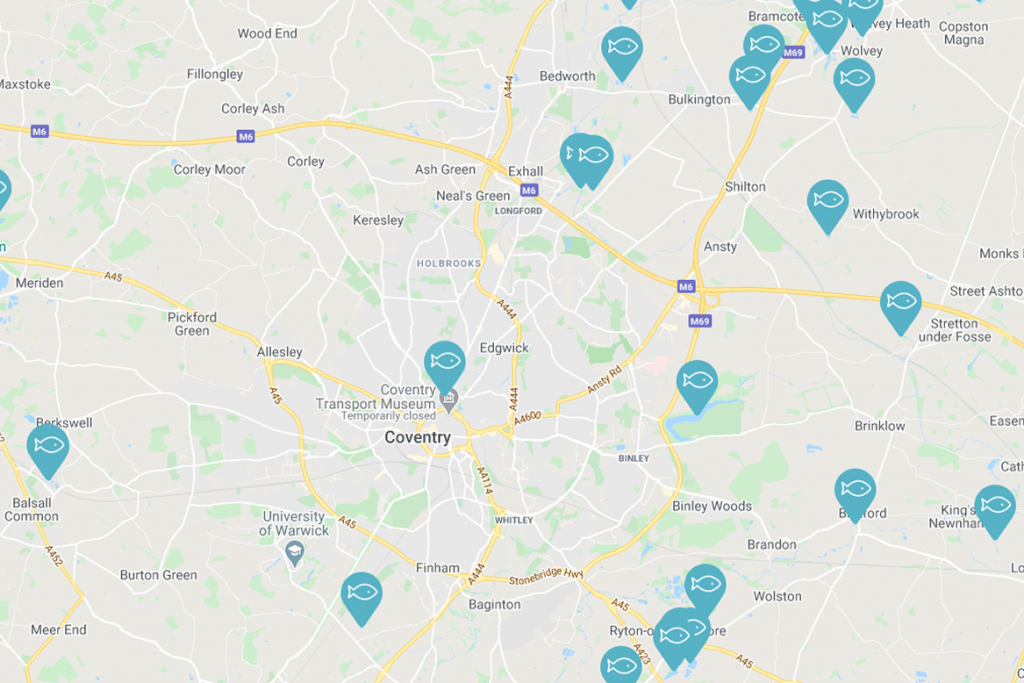
Accurate maps of fisheries are vitally important, especially to new members, but some clubs’ maps are woefully inadequate. Incomprehensible access instructions and badly drawn maps aren’t uncommon. Maps can easily be created using Google Earth and posted on the club website, and access points and limits can also be easily identified by What3Words.
Many clubs have moved to the use of credit card style membership ID. They are personalised, waterproof and practically indestructible, compact and can be a good advertisement for the club.
Social Media – most of us get most of our information from online sources. Most clubs already have websites (and those that don’t risk being left behind) but if younger members are to be recruited and retained, exploitation of social media is important. Not just Facebook, but Instagram, Tik Tok and Youtube can be useful avenues. WhatsApp can be a very useful platform for sharing information and is invaluable in enabling immediate notifications to members. It is also very helpful in emergencies.
Signage – signs are the public face of a club, they create the club’s ‘brand image’. They need to look professional and convey a positive image for the club. Badly designed signage, especially combined with bad spelling and grammar, reflects badly on the club. Ideally, all club signs should have the same design and font. Text needs to be concise and there is no point in stating ‘no litter’ , ‘offenders will be dealt with by the committee’ and the like. No litter lout has ever been dissuaded by a sign.
Signs like this …

should be all that is necessary, as anyone interested will access the website. Caution is recommended in the use of QR codes – scammers sometimes paste fake QR codes on top of genuine ones.
5. SHARING and MERGING

Membership of angling clubs has reduced in recent decades due to various factors. These include the increasing popularity in commercial fisheries, a declining match scene on ‘traditional’ waters, a perceived decline in river quality as well as general changes in society. Clubs which once had memberships in five figures sometimes struggle to survive as membership decreases and outgoings increase. Anglers show less loyalty to clubs and join only the clubs which offer the fishing they want. This can be regardless of any local connection the angler may have with the club’s location. As mentioned already, club membership has become purely transactional for many, and once thriving social clubs are in decline.
These factors mean that the traditional model of club, reliant on a strong local membership and with little competition other than other local clubs, is no longer robust. One way to help slow the decline is for clubs to co-operate with each other by sharing waters. Although this already happens, especially on some canals, there is still the opportunity on more natural waters for clubs to share costs and risk by allowing other clubs’ members to access ‘their’ fisheries. There are opportunities for large clubs to make alliances with not only similarly sized clubs, but also much smaller ones.
Merger of two or more clubs might be regarded as a radical step but it can have much to commend it. Some larger cities have two or more once thriving clubs which face the same challenges of declining membership and increasing costs. In the past, such clubs may have enjoyed a degree of rivalry (and not always friendly) and even in the present day they operate effectively in competition. Opportunities to work together should not be missed because of perceived differences – survival can even depend upon radical steps such as legal merger.
6. HEALTH AND SAFETY

Although angling isn’t inherently dangerous, fishers do encounter many risks when enjoying their sport. Not every member might be aware of such risks, and clubs should assess the risks most likely to be encountered on their waters and offer advice on how the risks can be managed, or avoided completely. Although every member is ultimately responsible for their own safety, clubs can help to ensure that sport is enjoyed safely.
Working parties present their own risks and there is well publicised case law of clubs being fined for injury caused during club organised work parties. Civil liabilities for serious injury caused by the club’s negligence can also run to many millions, and although insurance will often cover the risk, clubs need to do everything they can to avoid members – or anybody else – being injured during a working party.
An example of a form of club risk assessment is attached.
7. MAKING IT HAPPEN

A word of caution – in commerce, companies change how they operate, merge with each other, buy other companies or are bought out themselves every day. All are familiar processes needing diligence and professional support, but whose benefits outweigh the cost of the process. The old adage that ‘if you are not progressing you are going backwards’ applies even to small fishing clubs.
But angling clubs and their committee members, especially the longer serving, will sometimes resist change almost automatically. This doesn’t just apply to the big stuff like mergers, but often to any changes in the status quo. It is always easy to find spurious reasons to resist change, even when a club’s future is at stake. Of course, there are issues which need to be addressed, especially with major changes, but they are rarely insuperable and, if the decision to change is robust, they can be dealt with.
As an example, in the case of merger, obvious points to deal with include assets and liabilities (actual or potential), financial issues and reserves, transfer of properties to new club (landlord’s consent may be needed to transfer a lease) and data protection, safeguarding and health and safety matters. Fiddly, yes, but not insuperable.
Rule changes – if handled correctly, can be relatively easy to achieve. Change should never be for its own sake, but for sensible, justifiable reasons which benefit the club and enable it to operate more efficiently . The case for change must be ‘sold’ to members positively, sympathetically and effectively.
Once a decision has been taken in principle to refresh rules (or other documentation such as health and safety policies), the best way of implementing the change is to form a small working group of two or three members responsible for the task. It is impossible to draft rules by committee and the more people are involved in effecting change the worse the outcome is likely to be. But it is also very important to keep members carefully briefed on why changes are being proposed and the benefits they will offer. Members should always be given the opportunity to comment before being asked to approve a change (usually at the AGM) and careful briefing, FAQs are helpful in making the argument for the proposal.
It is much easier and more effective for the working group to start with a blank sheet of paper rather than trying to amend the existing rule framework. Bear in mind that existing rules framework may be generations old and might never have been fully reviewed. Patchwork changes might have been made, but without careful drafting the end result can be the proverbial dog’s dinner. The recommended approach is to look at examples of good practice elsewhere and to build up a clear and concise set of workable and realistic new rules. Only then is it appropriate to start to consider which of the existing rules should be preserved. By all means amend the new draft to reflect existing rules if they have not already been covered. But experience shows that it is surprising how rare it is to need to preserve old text, as when they are compared to more contemporary wording the existing text can appear cumbersome, and obsolete.
‘If it’s not broken don’t fix it’ – you’ll hear that a lot if you suggest changes to rules or constitution. Trouble is, unless you stress test the existing documents, you won’t know if they are still fit for purpose or not. A driver might enjoy years of safe motoring without wearing a seat belt , but that’s not a good argument for not wearing one. Remember that rules drafted years ago, perhaps in haste, might not help when the crisis comes – like the still common one which states that the club is never responsible for injury or damage, however caused. Try relying on that one when the club’s negligence caused the accident!
AND FINALLY – changing how a club operates, or even changing existing rules can be a challenge. Nobody likes change for its own sake, and it is vital to convince members what benefits will be achieved. The longer a club has been operating the more likely it is thought existing rules and practises are long overdue for an update. Don’t underestimate how difficult it can be to make those changes. But once the changes have been introduced, ensure that the club doesn’t wait for another decade to pass before reviewing the club documentation. There is a real benefit in including a standing item on AGM agenda to review key documents regularly. Don’t wait until it’s too late but keep the documents ‘alive’ and up to date.
Further Reading
1.1 Company documents are publicly accessible free of charge on the Companies House website here.
1.2 A link to company documents for a small angling club, including Memorandum and Articles of Association, is accessible here.
1.3 FAQs relating to the transition of a club from unincorporated association to CLG are available here.
2.0 An example of club rules is available here. These superseded an earlier set which had not been reviewed for decades and were no longer fit for purpose. They are for a small, closed membership club with a single water. They are deliberately brief and are the minimum needed for the circumstances of the club, and larger clubs will need more comprehensive rules sometimes with rules applying to specific venues.
They have been deliberately made as concise and easy to understand as possible. The club is a CLG, hence references to the board of directors. An unincorporated club could adopt similar rules by replacing references to the board with ‘committee’.
The rules’ primary purpose is to regulate the conduct of members while present on the club’s waters.
The rules complement the club’s company documents (or the constitution for unincorporated clubs) which cover matters such as how members can join the club, provisions for junior members and the club’s grounds for terminating an individual’s membership (e.g. non- payment of subs, breach of rules, or conduct bringing club into disrepute).
2.1 An example of a Health & Safety with Risk Assessment document for a medium size club is available here.
You might also like

Marine heatwave: what it means for sea anglers
Bluefin Tuna Catch-and-Release Recreational Fishery 2026
Rays of Tope: New project to unlock the secrets…
New ICES advice highlights mixed picture for key recreational…

Angling Trust welcomes UK ratification of landmark High Seas…

UK Government Pours Cold Water on Urgent Reforms to…

Anglers’ Data Stands Up to Scientific Scrutiny

Team England Fly Fishing on the Hunt for Medals…

Benjamin’s Comber confirmed as new British record

New British Carp Record
IFFA Spring Loch Style Fly Fishing International at Llyn…