


Anglers Against Pollution
WQMN Group of the Month: Citizen Science, Anglers and Local Action on the Hampshire Avon
The Angling Trust’s Water Quality Monitoring Network has become one of the most powerful citizens science initiatives in UK rivers, with more than 800 volunteers involved to date.
Every individual or group’s story who participate in the WQMN is unique. This blog is the first of a series of WQMN Group of the Month, where we hear from those driving the WQMN forward, uncovering the truth beneath the surface of their local rivers.
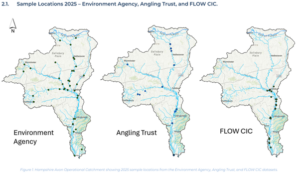
This month, we head over to the Hampshire Avon, hearing from Adam Ellis and Ella Abbott from For Love Of Water (FLOW), who have collected extensive data, following the WQMN methodology, and integrating their data alongside the Angling Trust’s and the Environment Agency’s. By combining multiple datasets, the power of each is multiplied, revealing pollution in greater detail than ever before.
Source: Microsoft Word – Avon Citizen Science Summary Jan 2026
What follows was written by ADAM and Ella from FLOW:
If you spend enough time beside a river, you get to know it. You notice when the water clears after rain. You notice when the Water Crowfoot starts growing. You notice when the fish are feeding, when the mayflies hatch, and when something just doesn’t seem right. That local knowledge is one of the reasons anglers have become such an important part of water quality monitoring on the Hampshire Avon.
At For the Love of Water (FLOW) CIC, we work to protect and improve rivers through restoration projects, fisheries work, citizen science and environmental monitoring. As a not-for-profit organisation, we do everything we can to achieve a simple aim: healthier rivers.
The Hampshire Avon is one of the world’s most important chalk streams, but it’s also a river under pressure. Nutrient pollution, sewage spills, agricultural runoff, abstraction, degraded habitat, and climate change all affect the health of the river and the wildlife that depends on it. Understanding those pressures starts with collecting good information.
The Value of Citizen Science
For several years, FLOW CIC has been working with volunteers, local farming clusters and eNGOs to collect water quality data across the Avon catchment. Volunteers regularly test for nutrients such as phosphate, nitrate and ammonia at sites throughout the river system.
The aim isn’t to replace regulatory monitoring. The Environment Agency collects essential data and provides the long-term records that help us understand how rivers are changing. What citizen science does provide is extra eyes on the river. Volunteers can sample more often, at more locations, and sometimes spot problems before they appear on anyone else’s radar. That additional coverage helps build a much clearer picture of what’s happening across the catchment.
Over the past year, data collected by volunteers have highlighted areas where nutrient levels remain elevated and identified occasional spikes in pollution that warrant further investigation. It’s exactly the sort of information that can help target future action.
Why Anglers Matter
Anglers have always been among the strongest advocates for healthy rivers. They’re on the bank in all seasons and all conditions. They know their local stretches better than almost anyone. When water quality deteriorates, fish behaviour changes, or pollution occurs, anglers are often the first people to notice. That makes the Angling Trust’s Water Quality Monitoring Network such an important initiative.
Across the Hampshire Avon, Angling Trust volunteers are collecting monthly water-quality data at several key locations. Their monitoring complements the work being carried out by FLOW volunteers and land managers, helping to extend the reach of the wider monitoring network. The strength of the programme isn’t just in the data. It’s in the people behind it.
Every sample taken represents someone giving up their time because they care about the future of their river.
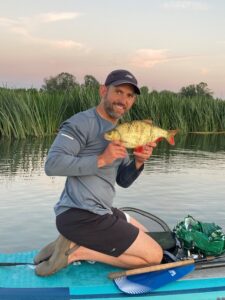
Daniel Gale, SW Lakes Trust, River Keeper at Royalty Fishery, WQMN Citizen Scientist, has been collecting dozens of samples as part of the WQMN. Data from Daniel and others have fed into Angling Trust and FLOW’s reports. SW Lakes Trust, FLOW, and the Angling Trust all want the same thing: a healthy, sustainable river that supports a thriving and diverse fish population.
Stronger Together
One of the biggest lessons we’ve learned is that no single organisation can tackle river pollution alone. The best results come when different groups work together and share information. On the Hampshire Avon, that means water users, farmers, conservation organisations, river trusts, local communities and regulators all playing a part.
By combining Environment Agency monitoring with citizen science data collected through FLOW and the Angling Trust, we’re building a much better understanding of river health across the catchment. The more complete that picture becomes, the better placed we are to identify problems, prioritise investment and measure improvements over time.
We are working with local Rivers Trusts, Wildlife Trusts and Wessex Water to collate information on river health in one place. We’re adding to this all the time, and you can view the data here https://riverhub.co.uk/.
Looking Ahead
There is still a huge amount of work to do. We want to expand monitoring to smaller tributaries, improve data sharing, and continue investigating locations where results indicate ongoing water quality issues. We also want to see more people involved in monitoring their local rivers, whether they are anglers, wild swimmers, or just interested in the local bit of water. We’ve managed to secure funding for two continuous water-quality monitoring Sondes, meaning we can back up citizen-science data with 24/7 monitoring.
The Angling Trust’s Water Quality Monitoring Network has shown what can be achieved when anglers are given the tools and support to contribute. Every sample collected adds to our understanding of these rivers and helps build the evidence needed to drive positive change.
For all the discussion about river pollution, it’s easy to focus on the problems. But one of the most encouraging things we see is the number of people willing to roll up their sleeves and help- for that, we are truly grateful. Whether it’s an angler taking a monthly water sample, a farmer monitoring a tributary, or a volunteer collecting data on a wet winter morning, they’re all contributing to the same goal: healthier rivers for fish, wildlife and future generations.
How did FLOW come about?
Adam set up For the Love of Water (FLOW) CIC in 2022 after 17 years of working for the Environment Agency and private-sector Environment Consultancies / Contractors. His professional background is in river monitoring (with a focus on fish) and practical restoration of river habitats. Adam has been an obsessive angler all his life, growing up a few meters from the River Welland in Lincolnshire, watching programs like ‘A Passion for Angling’, dreaming of these mythical rivers with Salmon, Barbel and monster Roach. Compared to the straightened, dredged River Welland I fished and swam in. Sitting watching ‘Passion for Angling’, the Hampshire Avon was as exotic as the Zambezi.
We moved to Downton, just a short walk from the mythical Hampshire Avon, in 2012, and absolutely fell in love with the river. It’s a bizarre privilege to be fishing some of the same spots I was watching Chris and Bob fish on the TV over 30 years ago, even if I don’t catch quite as much as they did.
Inspired by the work delivered by eNGOs like the Rivers Trusts, and the legendary Avon Roach Project. Adam set up For the Love of Water – FLOW for short, as a not-for-profit Community Interest Company in 2022. We deliver ‘river consultancy’ services across the UK, such as fish surveys, river restoration design and biodiversity net gain, and use profits to deliver our own projects to help protect and enhance the Hampshire Avon. We need to cover running costs and salaries, but beyond that, our only shareholder is the Hampshire Avon.
FLOW started out just me, with Maddie Crabb and Dr Daniella Montali-Ashworth joining as directors in 2024, followed by Ella Abbott as our Hampshire Avon Citizen Science Coordinator in 2026. Key achievements to date include working with community groups to secure DEFRA designation of two popular recreational spots on the Avon as Bathing Waters. This has already led to improved monitoring, identification of sewage leaks and significant investment in upstream sewage works. This benefits both people who use the river recreationally and the ecology that relies on good water quality. We’ve also established a network of volunteers who monitor water quality weekly and work with landowners to improve river habitat, increasing resilience to more extreme weather conditions.
What have you found out about the Hampshire Avon since you started monitoring?
Our citizen science data broadly follow the same trends as Environment Agency data, thereby validating the method. Due to successive budget cuts, EA teams need to prioritise their sampling, meaning some sub-catchments are monitored infrequently, or not at all. This leaves big data gaps, and in some cases, these waterbodies are being classified using outdated data. Now we have Ella in post, who will be looking for volunteers to help fill these data gaps.
While averages are similar between EA and Citizen Science data, we have found more spikes in Ammonia and Phosphate, suggesting localised pollution events are more common. The challenge now is to use this data to do something useful and to work with landowners to address any sources of pollution. We are lucky on the Avon; landowners are really engaged, and many land managers take regular water samples as part of our program.
How has the data helped inform the community/key stakeholders/campaigns about the state of the river?
We have lots of individual groups monitoring river health in the catchment, as well as the Environment Agency and the Water Company monitoring. We’re working with the Environment Agency, Catchment Partnership and Wessex Rivers Trust to develop a catchment-wide monitoring plan – we have clear objectives to help prioritise effort. We’ll share more when this is in place.
Citizen science monitoring has been a great tool for getting communities involved in conserving their local river. Much of the Hampshire Avon is inaccessible to the public, so opportunities to get a wider range of people involved are invaluable.
You might also like
WQMN Group of the Month: Citizen Science, Anglers and…
Andy Burnham becomes Prime Minister: here’s what he should…
Anglers to play key role in landmark shark conservation…
New Report Reveals the Hidden Workforce Behind the UK’s…

Marine heatwave: what it means for sea anglers
Bluefin Tuna Catch-and-Release Recreational Fishery 2026
Rays of Tope: New project to unlock the secrets…
New ICES advice highlights mixed picture for key recreational…
Angling Trust welcomes UK ratification of landmark High Seas…
UK Government Pours Cold Water on Urgent Reforms to…
Anglers’ Data Stands Up to Scientific Scrutiny